
It might sound like a strange question, but have you ever wondered – what is the most intensely valenced experience you’ve ever had—the sharpest pain and the purest pleasure—and what they have in common? What hidden axis connects them, and where do they diverge, beside obviously sitting on the opposite ends of the pleasure-pain spectrum? What other phenomenological aspects are inevitably pulled along with it as you stretch the intensity to the extremes?
Here is the true pickle about valence. It is so incredibly pervasive and ever-present in your consciousness, so intertwined with all other more-fleeting, accidental contents of your experience, that it’s hard to disentangle how it actually relates to them: to your bodily self, attention, time, objects, spatial perception, thought. Because it is always there, like undercurrent, it is actually most hard to isolate it and distill structure behind it, tease it apart and extract the deeper architecture that holds it all together.
The only way to get the first little glimpse of its mechanics is by examining the extremes – those moments where valence is pushed to its limits. At these boundaries something interesting starts to happen: valence finally reveals some structure in itself. Imagine a beautiful, delicate fabric draped over a wooden framework – when left loose, the frame remains concealed, lost in the folds – but when stretched taut, it begins to reveal the hidden form beneath it, the contours and edges that were almost entirely obscured before. So does valence, when stretched to extremes, it begins to pull other aspects of your experience somewhat asymmetrically, subtly altering your perception of body, stretching or contracting the sense of time, nudging your focus in slightly different directions, tipping the delicate balance between endo- and exogenous attention. And these are the invaluable clues about the actual mechanisms at play, the precious little threads we can cling to, the only ones we have, really, as we gently unravel this strange fabric.
This post is going to get personal, as I recall my experience during my worst pain (septic shock) and highest pleasure (MDMA+methedrone mix) – I’ll try to break down each separately, dissecting the sensory dimensions, the sense of bodily self, shifts in time, and changes in attention, and anything that stood out in phenomenology. From there, I’ll search for a synthesis, hoping to extract some clues about the mechanisms.
Phenomenology of my most intense pain
Let’s get the worst one out of the way. The most painful experience of my life came during septic shock. It crept up on me—first, a mild infection, the kind you assume will fade on its own. But the fever stayed. I felt grim and feverish for days, some strange discomfort that seeps deep into your body, weighing you down with a fatigue you can’t escape. Then my symptoms turned severe. A nosebleed, out of nowhere. The fever spiked, climbing higher and higher, indifferent to medication. Then one morning breathing became labored, each breath felt like a climb up a hill too steep, and then a deep, gnawing pain settled in my chest. By the time I reached the hospital, I was in full-blown sepsis, my body in chaos, inflammatory markers sky-high.
Sepsis is a pernicious thing, a betrayal from within, where your body’s greatest defense turns into your worst enemy. In its frantic effort to destroy an infection, your immune system releases a flood of signals, a cytokine storm, that spirals out of control. Blood vessels swell, collapse, and choke the organs they once nourished, cutting off oxygen. What should heal now strangles the heart, lungs, and kidneys as they falter and fade. The body’s fight becomes a siege, not on the invader, but on itself.
The sensory chaos: The pain of septic shock is unlike anything I had ever known—elemental, unyielding; it wasn’t sharp or sudden like a knife or broken bone; it wasn’t even localized anywhere, it was deeper, more primal, a searing ache that pulsed with every heartbeat, every shallow breath, it felt as though the pain was escaping me, almost spilling out of my skin, as if there was more than my body could contain. My organs, normally unnoticed as they quietly function, now I could really feel them all fighting for my attention in a chaotic uproar, each drowning, suffocating, crying out for oxygen.
The air felt thick, syrupy, impossible to pull in. I could feel it in my chest first, the weight of it, like a hand gripping my lungs, squeezing until my breaths were shallow and strained. My heart hammered, as if trying to break free, each beat sending waves of nausea crashing over me. In sepsis, as oxygen becomes scarce, cells are forced into anaerobic metabolism, switching to survival mode, but producing more lactic acid than the body can handle, and soon it floods your bloodstream. It really did feel like there was fire in my veins—a hot, burning sensation, racing through my body, the feeling of scorching from within, intensifying with each heart thump.
As my blood pressure continued to drop and they tried to keep it going, pumping fluids aggressively through the IVs, my body entered a surreal contradiction. My skin was both burning and freezing, alternating between fevered heat and a bone-deep cold that no blanket could warm. The pain kept radiated outward, creeping into my limbs until even the weight of my own body against the bed felt unbearable. And then the fear on top of it. It sat heavy in my chest, too thick to let me cry, and I’d never felt more alone—my family, which I really wanted to see that night were thousands of miles away, in a different timezone and I remember asking the nurse, quietly, if she could bring me another blanket, if she could stay with me, and if she could tell me that it was going to be okay. I knew she couldn’t know for sure, but in that moment, I just needed to hear it, even from a stranger.
Time: There was a strange disconnection in my sense of time – the minutes didn’t carry me forward. They just lingered, thick and heavy, I was suspended in an unbroken present. At some point, my mind began to lose its grip on how long I had been in this state. Time became less of a linear thread and more of a loop, replaying the same sensations over and over: the fever, the ache, the burning in my veins here and there — none of it seemed to end, only shift and mutate, leaving me trapped in a cycle I couldn’t break. Minutes felt like hours, and hours like days, and in the chaos of it all, I lost track of whether I was still in the world I had known, or if I had already crossed some unseen threshold, slipping into a timeless state where pain was all that existed. And in that distortion of time, I couldn’t help but wonder if this was what dying felt like—not a sudden departure, but a slow unraveling, where time itself dissolves into the background.
Attention and eye movements: Pain has a way of narrowing your world down to a pinpoint, the more intense it gets, the more laserfocused your attentional spotlight feels. It felt like there was no space left for me to direct my attention voluntarily anymore, “top-down”, it was constantly hijacked by every visceral sensation, my mind fixated on each jolt, every sharp edge of discomfort. Even my eyes seemed to rebel against me—they locked onto the room, scanning everything in a hyper-focus, desperate for an escape that wasn’t there. I could feel them darting from the IV in both of my arms to the harsh lights overhead, back and forth, searching for something, anything to alleviate what was happening to me. It felt like my whole body was screaming at me to pay attention to it, the body was all that existed, the external world shrunk to the absolute bare minimum.
Phenomenology of my most intense pleasure
Roughly a year after experiencing my most intense pain, I found myself compensating with an opposite extreme: the highest peak of pleasure I hadn’t even fathomed existed (and to be clear, this is not about the most profound or meaningful experience, but purely about the sensory pleasure). It was a warm night at a European music festival, the air warm and tinged with the scent of earth and distant pine. I was with someone I cared for deeply, surrounded by friends whose laughter mingled with the rhythmic pulse of music. The festival itself was a kaleidoscope of art and creativity, a place where strangers treated you like family and every moment felt like a celebration.
Before I dive into phenomenology, a disclaimer, this is a “don’t-try-this-at-home” section. I am not encouraging the mix of drugs I took (any drugs should be taken responsibly, and this is a risky combo). Mixing methedrone, a synthetic stimulant (4-methylmethcathinone), MDMA and cocaine is particularly dangerous because of how all of them affect the serotonin system. MDMA works by entering neurons via SERT, where it causes a massive release of serotonin into the synaptic gap. This flood of serotonin is what produces MDMA’s hallmark effects—euphoria, heightened empathy, and sensory enhancement. Similarly, mephedrone stimulates serotonin, dopamine, and norepinephrine release and inhibits their reuptake through their respective transporters (SERT, DAT, and NET), resulting in a surge of neurotransmitters that amplifies energy and pleasure further. When taken together, they might increase the risk of serotonin syndrome. Now, adding cocaine to the mix is even riskier – it primarily acts as a reuptake inhibitor for dopamine, but it also blocks SERT and NET. That means that on top of MDMA and mephedrone flooding the brain with these neurotransmitters, cocaine keeps them from being cleared out. I was however feeling quite confident in getting my doses just right, I voluntarily dived into it.
The sensory melting: It took an hour to ascent into the peak. I was dancing amid a sea of moving bodies, the music thumping like a collective heartbeat. Then it hit—a tidal wave of euphoria washing over my entire body. I felt weightless, as if gravity had relinquished its hold on me. My body no longer felt like a collection of limbs and organs but rather like a vessel of shimmering energy. My sense of self—the constant inner monologue, the awareness of “I”—simply evaporated. I was floating in a warm, luminescent space where the boundaries between me and the environment blurred until they vanished entirely, it was as if I had been woven into the fabric of night.
I remember thinking that everything is made out of silk and light. It wasn’t a hallucination like those experienced on LSD—my visual field remained intact, and I could see everything perfectly well. Rather, there was a subtle shift in the way things appeared, a gentle transformation that made the world seem softer and more radiant. The air was tangible, something I could move my fingers through and feel ripples spreading outward. My hands glided gently, as if conducting an invisible orchestra that played the music of bliss. My eyes softened, the usual sharpness giving way to a gentle focus that embraced rather than scrutinized. I danced with my eyes closed, yet I felt profoundly connected to everything and everyone.
There was just the dance, and it was perfect, effortless. Every movement felt like it added more bliss to an already overflowing reservoir. It wasn’t like an orgasm—it was not sexual—but it had that same intensity of release, surrender and unity. Everything was right. I didn’t need anything, didn’t search for more. There was nothing to seek out, nothing to desire, because everything I could ever need was encompassed in that moment. I existed in a silky cocoon of sensation, suspended outside of time and identity.
Attention and eye movements: As this peak dragged on, I noticed my friends were already starting to come down, but I remained in this state of pure euphoria for a while. It was then I noticed something remarkable about my perception—it only became apparent as I started to walk – my eyes, usually darting about to capture every detail, were utterly still. I even remember thinking that it almost feels as if now I had only one big eyeball rather than two, and something very steady residing deep within my skull holds it still. My gaze was as soft as it gets, unfocused, resting not on any particular object but embracing the whole scene in a gentle awareness. There was a profound peace in this stillness, a release from the constant hunger for new stimuli.
Was my attention more bottom-up (driven by external cues) or top-down (driven by deliberate focus)? It was kind of neither. It simply was—a steady flame in the quiet center of my mind. There was no compulsion to look elsewhere, no urge to shift my thoughts. Everything worth attending to was already present in that singular, all-encompassing moment. I recall thinking that I should write this down later, that this state of being was something precious and illuminating. But even that thought drifted by like a passing cloud, without stirring me to action. There was no urgency, no need to act.
Time: At first, with only the mephedrone, I felt a rush of energy, as though everything inside me moved fast while the world outside dragged. Time felt like endless cycles of rushing and pausing, losing its steady pace. But with MDMA in the mix, time transformed. Moments didn’t just pass; they layered upon one another, creating a rich tapestry without clear beginnings or ends. It felt like moments fused together more, less directionality, less urgency. Each second was rich, full, blurred into the next, perfectly content to stretch. And though time seemed to move forward, it felt unhurried, as if it were floating alongside me.
Each second was dense with experience yet light as a feather, a paradox of fullness and ease. The external world seemed to accelerate—I was astonished to realize hours had slipped by while I danced. I became aware of the subtle textures surrounding me—the way the cool night air caressed my skin, the softness of my dress against my body, the intricate interplay of shadows and light. Metaphors felt inadequate, yet they were the only tools I had. It was like being submerged in a warm ocean of honeyed light, each movement sending ripples through a golden ether. Or perhaps it was like being a note in a grand symphony, perfectly in tune with every other sound, part of a masterpiece unfolding in real-time.
Emerging from this state was gentle, like waking from a beautiful dream that lingers at the edges of your consciousness. The world slowly regained its familiar contours, my sense of self gradually reassembled. But the memory of that boundless bliss remained incredibly clear, and I still revisit it sometimes.
The synthesis
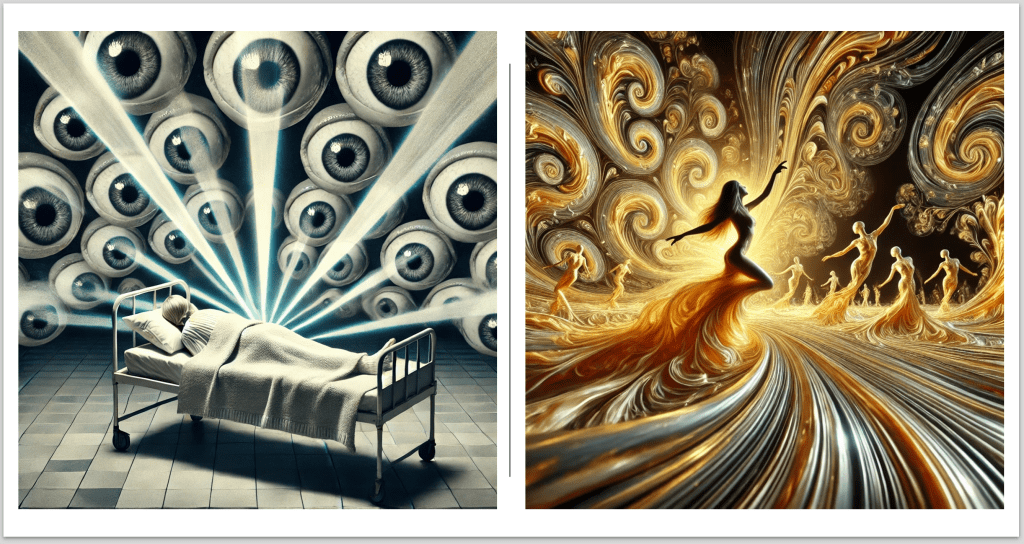
Standing atop the peaks of my most intense experiences of valence—the truly deep abyss of septic shock and the euphoric zenith of that luminous night—there are curious asymmetries unfolding, much beyond the obvious ones.
At my peak pain, my “bodily self” resurfaced from its usual seamless transparency to become the absolute entirety of existence. Normally operating beneath the surface of awareness, my body’s internal sensations flooded me completely, each organ demanding acknowledgment. The self wasn’t just present; it was overwhelming, magnified. In contrast, during my peak pleasure, the bodily self didn’t just become transparent—it dissolved even further beneath the surface. Physical boundaries blurred; the sensations of the body receded into a serene backdrop, allowing consciousness to expand outward. The sense of being in a body gave way to a feeling of unity with the surrounding world. The narrative self, too, dissipated. Stories, identities, and roles melted away, leaving only pure existence. Both the bodily self and the narrative self vanished into the tapestry of bliss, permitting a state of effortless being.
But comparing these peaks revealed more curious asymmetries beyond the bodily self: time dilated in pain but contracted in pleasure; attention sharpened in pain, but diffused in ecstasy; eye movements were rapid and chaotic in suffering, but still in bliss. These elements might seem unrelated, but they are incredibly interconnected, offering profound clues about the underlying mechanisms. I’d argue they all point toward the striatum, where these functions converge in an unobvious yet beautiful way.
Now about the mechanisms
The striatum, which I’ve explored in detail in another post, acts as a gatekeeper, its receptive fields attuned to “spatially and temporally-specific expected value”. It’s an incredibly beautiful structure that pays attention to your values, in both space (the head of the caudate) and time (the tail of the caudate). The striatum is stuck between two unidirectional crucial inputs, it doesn’t directly talk back to them, it only listens: from above – to the entirety of the cortex (“the raw, unvalenced sensory state”, a truly global snapshot from layer 5 across the cortices, a gist of all presently detected features); from below- to the substantia nigra pars compacta (the reward signal). These signals don’t mix yet, the striatum is their meeting point. And once they converge, the striatum quietly prepares its output: shaping which cortical state shall come next, by constraining the higher-order thalamus, which then reactivates new cortical ensembles.
In RL terms, the striatum is a causal embodiment of a value function, it remembers all kinds of coincidences when the cortical state and the reward met and it helps you arrive next time a state of a similar value, by then commanding the higher order thalamus (which I believe, must be a causal embodiment of a state-update function, which ultimately feeds back to the cortex itself, the state encoder). Striatum is just perfectly positioned as a selection engine, not only for motor actions (though it does that, too), but also as a selector for your thoughts and for your sensory attention (solid cases of sensory neglect and “blank mind” upon striatal lesions are very hard to question). It evaluates countless signals from the cortex, amplifying those that promise the greatest reward or pose the most urgent threat, and enhancing specific neural ensembles. Essentially, it chooses what matters most in any given moment.
Based on all literature I reviewed on it, it is also the only brain region I am aware of that causes a profound apathy when damaged – a loss of both positive and negative affect. The amygdala, the insula, the orbitofrontal cortex, the anterior cingulate—lesions to these regions can disrupt specific emotional dimensions: fear, disgust, somatosensory or affective component of pain. But none of them erase the very axis of caring itself. Only damage to the basal ganglia, and particularly the striatum, flattens the affective landscape so completely that the world ceases to register as better or worse. It doesn’t produce sadness—it produces indifference. I have some more formalizable ideas on how such a fan-in-fan-out architecture as implemented in the striatum, informed by both IIT and RL could underpin two very different types of global cause-effect structures, but more about this next time.
I would think, at the peak experiences, the striatal mechanism of selection becomes paralyzed, but it arrives there differently. I imagine, during intense pain, the striatal highlighter must be narrowing its selection to a razor’s edge, in a way the structure of pain, of its “cortical feature detectors” must be so that it can always reliably hijack striatal selection machinery and sustain it until you “get out”. This sharp focus clamps down on attention, funneling all mental resources toward finding an escape, exerting a high pressure on the higher order thalamus to “update” the cortical state (more pressure to update, denser the stream of consciousness, hence time dilation). Conversely, in the boundless expanse of overwhelming pleasure, the striatal pointer finds itself inundated. When every facet of experience holds high expected value, the usual mechanisms for selecting and enhancing specific neural ensembles become saturated and cannot choose anymore, because they do not need to. The striatum, awash in a sea of optimal signals, cannot prioritize one sensation over another. It’s as if the highlighter has nothing specific to emphasize because everything is equally radiant. In my peak pleasure, attention rested gently, embracing the entirety of the moment without discrimination. My eyes softened and grew still; there was no urge to seek out new stimuli because all was perfection. No selection within the striatum yielded no selection in my superior colliculus (superior colliculus is always understood in neuroscience as guiding eye movements, but it is basically a slave of striatum, in another post, I’ll try to cover how mechanisms of valence and attention must partially overlap in more detail).
The striatum doesn’t just select what we attend to; it shapes how we exist in each moment. In pain, it drives us inward, sharpening the self against the whetstone of necessity. In pleasure, it releases its grip, allowing us to meld seamlessly with the world around us. Both aspects of the self—the bodily and the narrative—recede, granting us access to a state of unity and boundless presence.
I will end with questions, that stand out for me, after the whole analysis. Let’s say we have enough evidence that the striatum indeed profoundly influences your next “cortical state”, i.e. does the selection. At which moment, exactly, is the valence assigned? Is it the moment dopamine cascades into the striatum, the strengthening or weakening of the most currently active corticostriatal synapses? Or does it come with the closure of the loop through the higher thalamus—a delicate touch of alignment, when what’s valued merges with what is, a sensation of ease, a soft release from the need to alter the flow? Perhaps it is in that quiet moment when the cortical rhythms slow, harmonizing effortlessly? Is it in the cortex itself, not needing to press onto the striatum to urgently realign, to readjust what is? Because it is all a loop, it is extremely difficult to disentangle the actual causal factors from the background conditions, but certain careful experiments can manage to separate them.
Painting by Z. Beksinski.
 valence hacking
Leave a comment